
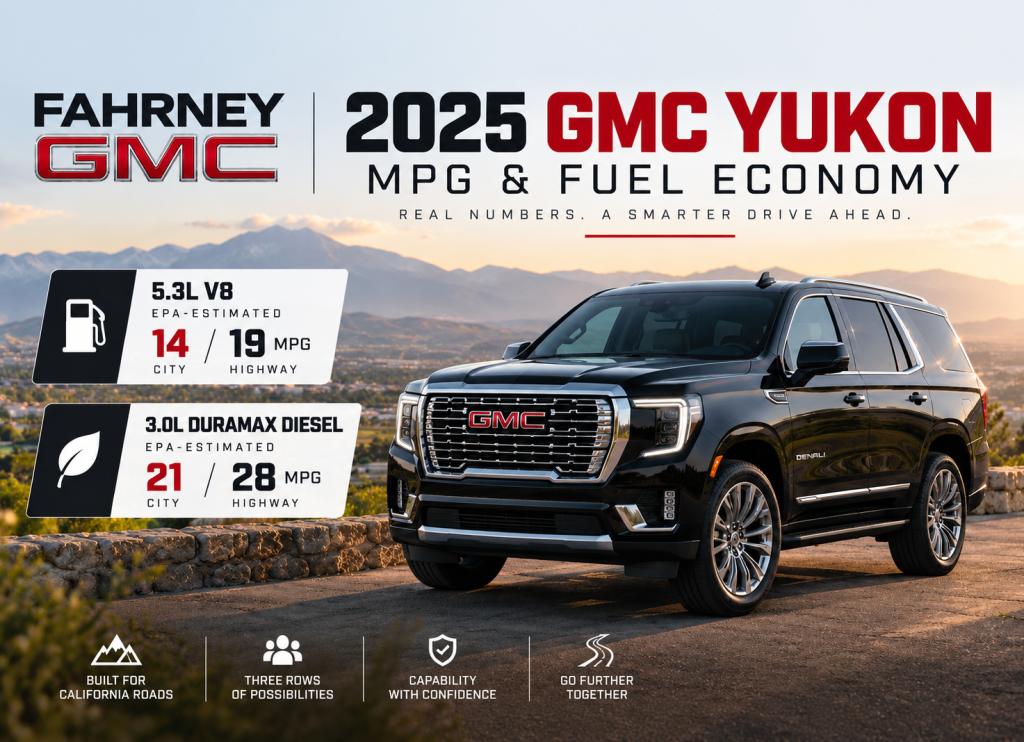
2025 GMC Yukon MPG varies by engine and drivetrain, with the available Duramax diesel offering the highest fuel economy.
The GMC Yukon delivers up to 21 MPG highway on its most efficient configuration, making it one of the more fuel-conscious full-size SUVs in its class. Whether you are commuting through Selma or hauling the family across Fresno County, understanding which Yukon trim and engine combination suits your driving habits can save you real money at the pump each year. This guide breaks down every EPA rating, explains the real-world factors that affect efficiency, and helps you choose the right Yukon for your lifestyle.
What Is the Fuel Economy of the GMC Yukon?
The GMC Yukon's fuel economy ranges from 14 MPG city / 18 MPG highway on the 6.2L V8 with 4WD to 21 MPG city / 28 MPG highway on the available 3.0L Duramax diesel in 2WD configuration. EPA ratings vary by drivetrain (2WD vs. 4WD) and engine selection, so comparing configurations side by side is the most reliable way to estimate your real-world range.
Quick Answer: The base 5.3L V8 Yukon with 2WD earns an EPA-estimated 16 MPG city / 20 MPG highway / 18 MPG combined. Choosing 4WD typically reduces those figures by 1 to 2 MPG depending on the engine.
How Does GMC Yukon MPG Compare Across Trim Levels?
Every Yukon trim — SLE, SLT, AT4, Denali, and Denali Ultimate — shares the same engine options, so fuel economy differences between trims are minimal. The more significant variable is engine choice and drivetrain. Heavier packages such as the Denali add some curb weight, which can have a small effect on real-world efficiency under demanding driving conditions, but the EPA-rated numbers remain the same across trims for a given engine and drivetrain pairing.
GMC Yukon MPG by Engine and Drivetrain
| Engine | Drivetrain | City MPG | Hwy MPG | Combined MPG |
|---|---|---|---|---|
| 5.3L V8 EcoTec3 | 2WD | 16 | 20 | 18 |
| 5.3L V8 EcoTec3 | 4WD | 15 | 20 | 17 |
| 6.2L V8 EcoTec3 | 2WD | 14 | 19 | 16 |
| 6.2L V8 EcoTec3 | 4WD | 14 | 18 | 15 |
| 3.0L I-6 Duramax Diesel | 2WD | 21 | 28 | 24 |
| 3.0L I-6 Duramax Diesel | 4WD | 20 | 26 | 22 |
Source: EPA fuel economy estimates. Actual results vary with driving conditions, load, and vehicle configuration. Confirm current ratings at fueleconomy.gov.
Is the GMC Yukon Diesel Worth It for Better Gas Mileage?
The Yukon's available 3.0L Duramax diesel engine offers the best fuel economy in the lineup, returning up to 28 MPG highway in 2WD form. For drivers who cover long distances on California's highways — whether running State Route 99 between Selma and Fresno or heading out across the Central Valley — the diesel can meaningfully reduce annual fuel costs compared to either V8 option.
The tradeoff is a higher upfront purchase price and the need to find diesel fueling stations. Diesel is widely available throughout Fresno County, including stations convenient to the Selma area, though availability can thin out in some of the more rural corridors east and west of the valley floor.
A practical rule of thumb: If your driving is primarily highway miles and you put significant mileage on your vehicle each year, the Yukon diesel's efficiency advantage is worth evaluating closely. For mostly city driving or shorter daily trips around Selma, the 5.3L V8 may be the more straightforward and cost-effective choice.
What Factors Affect Real-World GMC Yukon Fuel Economy?
Real-world Yukon MPG regularly falls within 1 to 3 MPG of EPA estimates under normal driving conditions, but several variables can move results outside that range. Driving style is the single largest factor — aggressive acceleration and repeated hard braking can reduce efficiency noticeably compared to steady highway cruising.
Key factors that impact Yukon fuel economy:
- Towing and payload — towing near the Yukon's maximum rated capacity puts significant demand on the drivetrain and reduces highway efficiency
- Tire pressure — under-inflated tires increase rolling resistance; check pressure monthly, particularly during California's seasonal temperature changes between summer heat and cooler winter mornings
- Drivetrain selection — 4WD reduces efficiency by 1 to 2 MPG compared to 2WD; use 2WD or Auto 4WD when road conditions allow
- Speed — fuel economy drops at speeds above 65 MPH due to aerodynamic drag on a vehicle the Yukon's size
- Air conditioning use — the Central Valley's hot summers mean A/C runs hard for months; heavy climate control use in stop-and-go traffic can reduce MPG, so pre-cooling the cabin before departure helps reduce the initial load
- Dynamic Fuel Management — the 5.3L and 6.2L engines use GMC's Dynamic Fuel Management system, which deactivates cylinders at light throttle loads; this technology works best when left in its factory configuration
How Can You Improve GMC Yukon Gas Mileage Day to Day?
Consistent driving habits and routine maintenance can improve your Yukon's real-world fuel economy without any modifications or added expense. The most impactful changes cost nothing at all.
Practical tips for better Yukon MPG:
- Accelerate gradually and anticipate stops to minimize unnecessary braking
- Use cruise control on California's long, flat stretches of highway to maintain a consistent speed
- Keep tires inflated to the specification shown on the driver's door jamb sticker
- Remove roof cargo carriers or roof racks when not in use — they add meaningful aerodynamic drag at highway speeds
- Follow GMC's recommended oil change intervals and use the specified oil viscosity for your engine
- Avoid extended idling when parked; modern engines reach operating temperature faster when the vehicle is moving
- When possible, run errands in a single trip rather than multiple short cold starts, which are less efficient for fuel economy
How Does the GMC Yukon XL Fuel Economy Compare to the Standard Yukon?
The GMC Yukon XL returns identical EPA fuel economy ratings to the standard Yukon because both share the same engines and drivetrain options. The XL's longer wheelbase and expanded cargo area add curb weight, which has a negligible effect on the EPA test cycle numbers. Under real-world conditions — particularly when the XL is loaded to capacity with passengers and cargo — drivers may notice a slight decrease compared to a lightly loaded standard Yukon, but for most day-to-day driving, the numbers track closely with the figures in the table above.